
A freely available graduate-level textbook on wireless communication fundamentals, covering MIMO, space-time coding, OFDM, CDMA, opportunistic communication, and channel capacity. The book includes exercises, lecture slides for instructors, and has been adopted at over 50 universities worldwide including MIT, Berkeley, and Princeton. A 2-day short course based on the book is also offered by the authors.
Nguồn: https://web.stanford.edu/~dntse/wireless_book.html. 8sync News chỉ tóm tắt và dẫn link; bản quyền nội dung thuộc tác giả và nguồn gốc.
Đọc tin ở đây, luyện code, học theo lộ trình và luyện IELTS trên các sản phẩm anh em — tất cả kết nối với nhau trong hệ sinh thái 8 Sync Dev.
Cổng chính của hệ sinh thái: giới thiệu sản phẩm, blog và bảng giá trọn bộ.
Khám pháHọc theo lộ trình với video, quiz chấm tự động, certificate và mentor đang làm nghề.
Xem khóa họcLuyện thuật toán chấm tự động 7 ngôn ngữ, chạy code ngay trên trình duyệt.
A developer built a system where a live drummer controls tempo instead of following a machine clock. The post covers the core technical challenges: why kick-drum triggers fail as clocks, why clock multiplication requires a tempo model, and how a software phase-locked loop with a beat-aware front end solves the problem. Key insights include distinguishing feel (small deviations) from real tempo drift, the critical 'coasting' behavior that keeps the system running during fills or confidence dips, and scheduling notes against a forecast rather than reacting to hits. The result is DrumMate, an Android app where a generated band follows a drummer's tempo and dynamics over USB MIDI.
AI cho doanh nghiệp B2B: chat đa kênh AI phản hồi, gom lead tiềm năng, phân loại khách hàng.
Sắp ra mắt
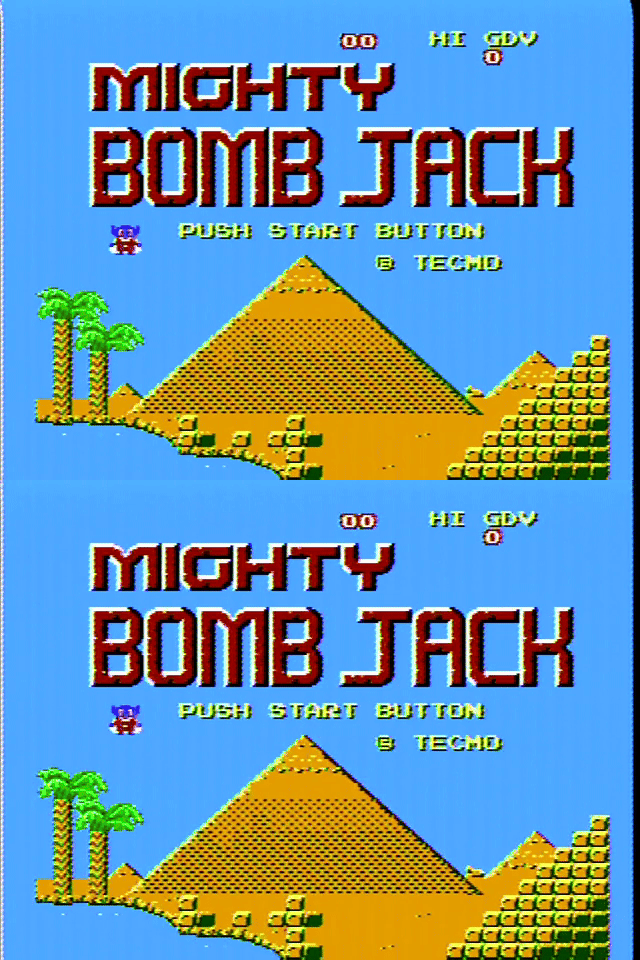
A deep technical dive into why the NES produces a wobbly composite video image. The NES PPU generates color signals directly in the composite domain using a 21.47727 MHz oscillator divided to produce 12 color phases, resulting in 227.33 colorburst cycles per scanline rather than the ideal 227.5. This creates a three-line repeating artifact pattern. Ricoh's engineers addressed this with a 'missing dot' trick — alternating scanlines between 341 and 340 dots — reducing the visible pattern to a two-frame alternation. The post also covers how games like Battletoads that disable rendering to access VRAM bypass this correction, revealing the underlying three-frame pattern.
Digital blood pressure monitors using the oscillometric method are less accurate than commonly assumed. These $30-50 devices inflate an arm cuff and detect pressure oscillations during deflation, using fixed percentage thresholds (e.g., 40% and 80% of oscillation amplitude) to estimate systolic and diastolic values — an approximation rather than a direct measurement. Category A monitors are only required to land within ±15 mmHg for 85% of readings. To investigate this, Milos Rasic built the Open Cardiography Signal Measuring Device, an open-source platform that combines arm cuff pressure sensing with PPG, ECG, and digital stethoscope inputs to test alternative measurement algorithms and evaluate off-the-shelf monitor accuracy.
MIT researchers have developed a portable ultrasound system aimed at making breast cancer screening more accessible and frequent. The new system features a backing layer added to the ultrasound transducer that improves image resolution and reduces noise, plus an adaptive beamforming algorithm that compensates for varying sound speeds across tissue types, yielding up to 10% resolution improvement. A computer-vision-based user interface guides non-expert users to position the probe correctly, enabling consistent longitudinal monitoring. In trials, untrained volunteers successfully located embedded targets at higher rates than with traditional probes. The team plans to develop a smartphone-compatible version and is exploring commercialization, with potential applications beyond breast cancer to ovarian cancer, endometriosis, and fetal monitoring.
Consumer wearables report different heart rates for the same person due to several compounding factors. All wrist and finger wearables use photoplethysmography (PPG), but sensor placement matters — finger-based devices like Oura Ring sit closer to surface arteries and move less during sleep, giving them an accuracy edge over wrist devices. Sampling rate also plays a major role: WHOOP samples 26 times per second continuously, while Apple Watch and Garmin use periodic or adaptive sampling. Beyond hardware, proprietary algorithms translate raw light signals into heart rate values, and software updates alone can shift reported numbers without any hardware change. Additional variables include skin tone (melanin absorbs more light, reducing signal quality), tattoos over sensor areas, and device fit on the wrist. During exercise, motion artifacts further diverge readings between brands. The practical takeaway is that cross-device comparisons are unreliable; what matters is consistent trends on a single device over time.