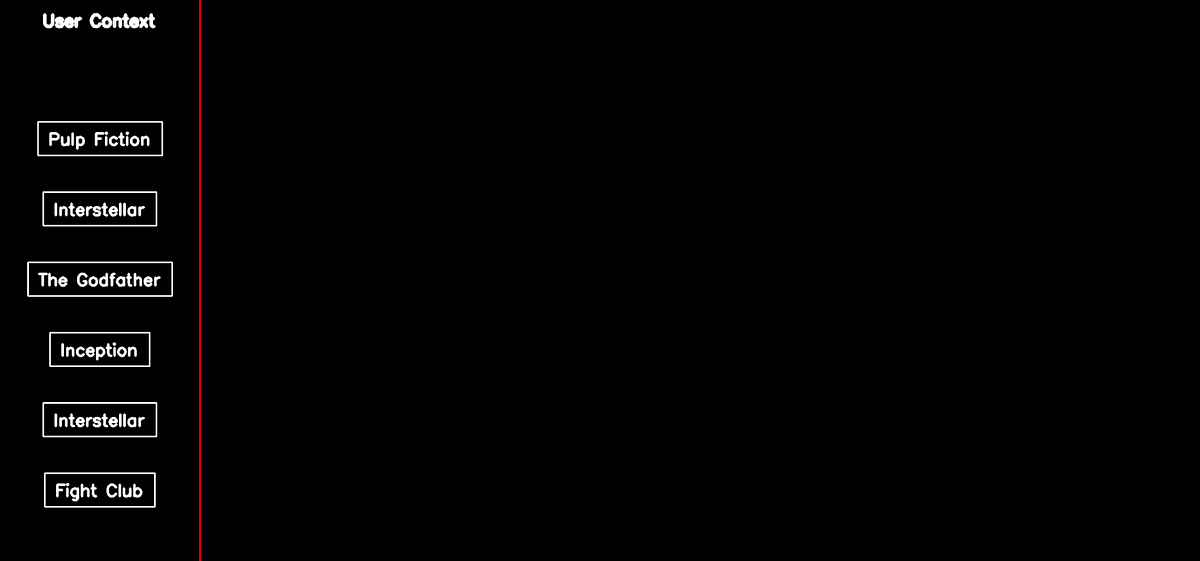
Netflix introduces GenPage, a generative transformer model that replaces the traditional multi-stage homepage recommendation pipeline with a single decoder-only model. Treating user history and request context as a tokenized prompt, GenPage autoregressively generates the full two-dimensional homepage layout — rows and entities together — in real time. The system uses a domain-specific tokenizer for efficiency and product control, a pretraining-then-post-training recipe (either weighted binary classification or GRPO-based RL), and production-specific techniques including semantic embedding fusion for cold start, multi-cadence incremental training, constrained decoding for business rules, and hybrid row decoding for latency. In online A/B tests against a mature production system, GenPage achieved statistically significant gains on the core engagement metric while reducing end-to-end serving latency by 20%. Offline findings show that enriching the prompt context outperforms scaling model capacity in the current regime, and RL post-training increases homepage diversity even without an explicit diversity objective.
Nguồn: https://netflixtechblog.com/genpage-towards-end-to-end-generative-homepage-construction-at-netflix-77146fba8a08. 8sync News chỉ tóm tắt và dẫn link; bản quyền nội dung thuộc tác giả và nguồn gốc.
Đội kỹ thuật của Gusto xây dựng bộ phân loại chuyển tiếp AI-sang-người cho hệ thống hỗ trợ khách hàng bằng cách bắt đầu với prompt LLM, sử dụng dữ liệu sản xuất để tạo dataset 3.500 lượt hội thoại, sau đó tinh chỉnh mô hình BERT nhẹ đạt 94% precision và 93% recall. Phương pháp LLM-đầu-tiên-sau-chuyên-biệt phù hợp cho quyết định ổn định, khối lượng lớn như phân loại intent, nhưng không hiệu quả với sinh văn bản mở hoặc quy tắc thay đổi.
Lập trình viên nên đọc bài này để hiểu cách chuyển từ việc sử dụng mô hình LLM trực tiếp sang xây dựng hệ thống chuyên biệt hiệu quả, đặc biệt là trong trường hợp phân loại quyết định cụ thể như phân luồng hỗ trợ khách hàng, giúp tối ưu hóa chi phí và tốc độ triển khai.
Google Cloud vừa giới thiệu TPU Developer Hub, một nền tảng giáo dục tập trung dành cho nhà phát triển ML sử dụng TPU, bao gồm kiến trúc phần cứng, stack phần mềm (XLA, Pallas kernels), công cụ gỡ lỗi XProf, chiến lược tối ưu hóa (như offloading KV cache) cùng networking và bảo mật. Nội dung đa dạng từ Colabs tương tác, mã nguồn mở đến tài liệu chuyên sâu, hỗ trợ tích hợp AI-assisted development.
Lập trình viên ML nên đọc để hiểu cách tối ưu hóa hiệu suất và chi phí của mô hình trên TPU với các công cụ mới như XLA, Pallas và các chiến lược parallelism, từ đó tiết kiệm thời gian và nguồn lực trong triển khai sản phẩm AI.
Z.ai vừa ra mắt GLM-5.2, mô hình nguồn mở 753 tỷ tham số (MIT license) tối ưu cho các tác vụ lập trình dài hạn nhờ nhiều cải tiến như cửa sổ ngữ cảnh 1 triệu token, kiểm soát "effort-level" cân bằng hiệu suất-latency, và kiến trúc IndexShare giúp giảm 2,9 lần FLOPs/token. Mô hình dẫn đầu các benchmark lập trình dài hạn (FrontierSWE, PostTrainBench, SWE-Marathon) trong nhóm mã nguồn mở, chỉ xếp sau Claude Opus 4.8, đồng thời hỗ trợ các framework suy luận phổ biến như vLLM và SGLang.
Lập trình viên nên đọc bài này vì GLM-5.2 là một mô hình AI mạnh mẽ cho các nhiệm vụ lập trình dài hạn, giúp tối ưu hóa hiệu suất và độ chính xác trong việc xử lý các dự án phức tạp, từ việc viết code đến tối ưu hóa logic, với các tính năng như hỗ trợ context rộng và kiến trúc hiệu suất cao.
An end-to-end classical NLP experiment on Kaggle's Spooky Author Identification task, progressively building from a Vowpal Wabbit word baseline to a tuned stacked ensemble. The pipeline covers style-aware feature engineering (punctuation, character n-grams, TF-IDF), NB-SVM-style logistic regression, and stacking with out-of-fold predictions to avoid leakage. A representation survey compares sparse features (Bag-of-Words, BM25) against dense embeddings (Word2Vec, FastText), finding that sparse n-gram features outperform averaged dense vectors for short-text authorship attribution. The final stacked model achieves 0.8687 accuracy and 0.3504 log loss on a 70/30 holdout, and 0.30414 private log loss on Kaggle.
Proception, a robotics startup founded by ex-Tesla Optimus engineer Jay Li, has settled a year-long trade secret lawsuit with Tesla and raised an $11M seed round led by First Round Capital. The company is now shipping its first dexterous robotic hands — featuring 22 degrees of freedom and a sensor-laden glove for scalable training data collection — to researchers and robotics companies. Tesla had sued Li in June 2025, alleging he downloaded confidential files before leaving to found Proception. The dexterous hand market is heating up globally, with competitors like China's Linkerbot dominating market share and European and Chinese startups raising hundreds of millions. Proception is betting that humanoid robot makers will outsource hand manufacturing rather than build in-house, positioning itself as a key supplier in the emerging humanoid robot supply chain.
WiMi Hologram Cloud is researching neural network models to optimize parameter selection in twin-field quantum key distribution (TF-QKD) systems. Three models were evaluated: BPNN, RBFNN, and GRNN. RBFNN and GRNN showed higher prediction accuracy in high-dimensional parameter spaces, while BPNN offered the fastest computation speed. Compared to traditional local search algorithms (LSA), neural network-based prediction reduced computation time by multiple orders of magnitude. Future work will explore deep learning and reinforcement learning approaches, with plans to integrate the technology into quantum communication hardware for practical deployment.
Hexora v0.3 is a Python library for detecting malicious PyPI packages using static analysis. The new release adds a gradient boosting machine learning model that analyzes code structure, semantic features, and static analysis results to assess entire Python files. The ML model's primary role is filtering false positives — previously yielding 5-10 false positives per real finding. Running against newly published PyPI packages, it now detects 2-10 malicious packages daily. Remaining false positives mostly come from AI-related projects that use dynamic code execution, base64-inlined assets, or telemetry.
Researchers at Princeton have developed AI-driven methods to automate the design of radio-frequency integrated circuits (RFICs), a process traditionally considered a 'dark art' requiring years of expert experience. Using reinforcement learning to determine circuit architecture and topology from scratch, combined with an AI emulator that predicts electromagnetic behavior without running full simulations, the team produced a 5G millimeter-wave power amplifier that outperformed state-of-the-art human designs. They also applied diffusion models to make AI-generated circuit structures more interpretable by engineers. The approach eliminates reliance on human-designed templates, dramatically reduces design time from months to minutes, and has been validated for multiport circuits and sub-terahertz amplifiers. Key remaining challenges include reducing AI hallucinations, improving generalizability, and building open datasets — since most simulation data is locked behind NDAs.