Loading feed…

LinkedIn Engineering0 Hot0 comments11 min read
Profile Relevance: Boosting Feed Relevance with LLMs at LinkedIn
LinkedIn built Profile Relevance, an unsupervised retrieval system using LLM-generated embeddings to match members with posts outside their network. It compares Rewrite (condensed text, cheaper) versus Non-Rewrite (raw text, richer context) embedding approaches, and appends country names to recover geographic signal lost in rewriting. An AutoEval LLM-judging pipeline scaled evaluation from 20 to 1,000 human-labeled records per model. Incremental profile updates cut compute to 24% of a full-refresh baseline, and horizontal GPU scaling beat vertical scaling. Online tests showed a +0.54% lift in Feed Updates Viewed, +0.94% viral rate, -18.8% hide rate, and +17.7% viral engagement gain for cold-start members.
Source: https://www.linkedin.com/blog/engineering/feed/profile-relevance-boosting-feed-relevance-with-llms-at-linkedin. 8 Sync News only summarizes and links out; content copyright belongs to the authors and original sources.
8 Sync ecosystem
One account, the whole ecosystem
Read the news here, practice coding, follow structured courses and train for IELTS on our sibling products — all connected through one 8 Sync account.
8syncdev.com
8syncdev.comThe ecosystem home: product overviews, blog and full pricing.
ExploreCourses
course.8syncdev.comLearn along a clear roadmap: videos, auto-graded quizzes, certificates and mentors who ship for a living.
View the roadmapCoding practice
coding.8syncdev.com1,000 DSA problems in Vietnamese, auto-graded across 7 languages — many FREE, right in your browser.
Practice for freeIELTS
ielts.8syncdev.comAI grading for all four IELTS skills with detailed rubric feedback.
Try it freeZUS — AI IDE
zus.8syncdev.comA 22 MB AI IDE for Vietnamese devs.
Download freemind0
mind0.8syncdev.comOrganizational memory for AI agents.
ExploreAcoLeads
home-acoleads.8syncdev.comAI that staffs your Fanpage and qualifies leads for you.
Try itRecommended for you

Flavio Copes1 Hot12 min
API pricing vs subscription: what my month of Codex would cost on the API
I priced 30 days of my real Codex usage at API rates. A $100 plan covered $745 of API-equivalent work. Here's the math, the script to run on your own logs, and when the API still wins.

Latest Hacking News1 Hot7 min
Red Flags to Watch for When Choosing Between AI Pentesting Vendors
Choosing between AI pentesting vendors requires looking past marketing labels like 'autonomous' or 'agentic' because the underlying systems vary widely. A Stanford-led study ran different AI agent frameworks against a live 8,000-host network and found that between 55% and 82% of reported findings were confirmed as real vulnerabilities. Swapping only the underlying model moved one framework's valid finding rate from 57% to 80%, yet that same framework still scored lowest overall since its findings stayed shallow. On a CTF-style benchmark two frameworks scored near-identically (48.6% vs 45.9%), but on the live network one scored nearly three times higher on severity and complexity. Buyers should demand proof of exploitation, real-network results, clear safety controls, data handling answers and clarity on what 'continuous' actually means.

freeCodeCamp136 Hot2 min
Learn Vector Databases for Beginners – Embeddings, Similarity Search & ChromaDB
A vector database stores data as lists of numbers called embeddings, which lets it search by meaning instead of matching exact keywords. It's the piece behind a lot of recommendation systems, RAG apps
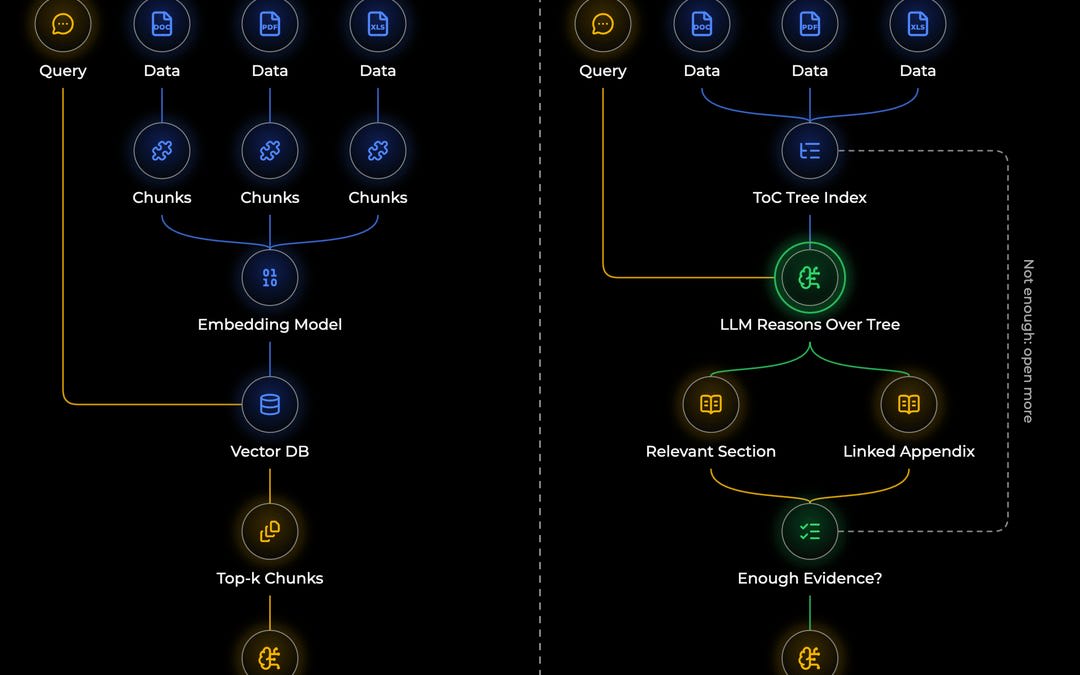
Daily Dose of Data Science | Avi Chawla | Substack152 Hot7 min
RAG vs. Vectorless RAG, clearly explained!
...explained visually (with tradeoffs in production).

Medium40 Hot9 min
DeepSeek Super-Agent Architecture Explained
How DeepSeek Harness's Super-agent works: a Router, isolated Workers, event triggers and a Watchdog let one AI agent run many tasks. Diagrams inside.

MongoDB1 Hot6 min
AI Search for Agents: Announcing Automated Embedding in MongoDB Atlas
See how Automated Embedding in MongoDB Vector Search solves the hardest problems in AI search for agents.

Hacker News23 Hot23 min
How I use AI (Oct 2026)
I document how I use AI, one year after my first writeup. Everything's completely different.

Couchbase21 Hot12 min
Vector Database Use Cases: Search, RAG, and AI Apps
The most common vector database use cases are semantic search, RAG, recommendations, and multimodal search. Learn how each works and when to use them.
Comments
Loading comments…