Consumer wearables report different heart rates for the same person due to several compounding factors. All wrist and finger wearables use photoplethysmography (PPG), but sensor placement matters — finger-based devices like Oura Ring sit closer to surface arteries and move less during sleep, giving them an accuracy edge over wrist devices. Sampling rate also plays a major role: WHOOP samples 26 times per second continuously, while Apple Watch and Garmin use periodic or adaptive sampling. Beyond hardware, proprietary algorithms translate raw light signals into heart rate values, and software updates alone can shift reported numbers without any hardware change. Additional variables include skin tone (melanin absorbs more light, reducing signal quality), tattoos over sensor areas, and device fit on the wrist. During exercise, motion artifacts further diverge readings between brands. The practical takeaway is that cross-device comparisons are unreliable; what matters is consistent trends on a single device over time.
Source: https://www.freecodecamp.org/news/why-different-wearables-report-different-heart-rates. 8 Sync News only summarizes and links out; content copyright belongs to the authors and original sources.
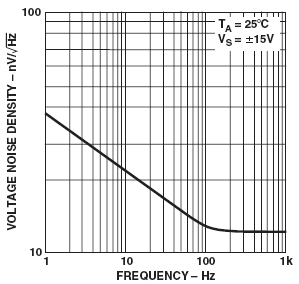
Bài viết khám phá mối quan hệ giữa các cặp biến đổi Fourier theo luật power-law với nhiễu 1/f, trường hợp đặc biệt α = -0.5 tự biến đổi, và vai trò quan trọng của phase cùng Γ(α+1).
Lập trình viên nên đọc bài này để hiểu cách Fourier biến đổi giúp giải quyết vấn đề nhiễu 1/f trong dữ liệu thời gian thực, từ đó tối ưu hóa hiệu suất xử lý tín hiệu và dự đoán trong các ứng dụng AI, tín hiệu kỹ thuật số và phân tích thời gian thực.
Bài viết giới thiệu cách mô phỏng bộ điều khiển PID (Proportional-Integral-Derivative) trực quan trên Google Sheets mà không cần lập trình, giải thích vai trò của từng thành phần P, I, D và các vấn đề thực tế như derivative kick, integral windup cùng noise amplification. Kết luận nhấn mạnh rằng không có bộ cài đặt PID tối ưu chung, mà phụ thuộc vào đặc tính của hệ thống điều khiển.
Một lập trình viên nên đọc bài này để hiểu cách PID hoạt động thực tế thông qua mô phỏng trực quan, giúp họ thiết kế và tối ưu controller hiệu quả mà không cần kiến thức về tính toán calculus phức tạp.
Bài viết giới thiệu các bộ lọc đệ quy đơn giản từ trung bình động (SMA, EMA) đến bộ lọc low-pass và cập nhật một chiều của Kalman, nhằm cung cấp giải pháp làm mịn dữ liệu hiệu quả.
Lập trình viên cần đọc bài này để hiểu cách triển khai hiệu quả các thuật toán lọc đệ quy—như SMA, EMA, lọc thấp tần—với chi tiết về hiệu suất và ứng dụng trong xử lý tín hiệu, giúp tối ưu hóa code cho các ứng dụng thời gian thực.
Abstract page for arXiv paper 1202.4212: Harmony Explained: Progress Towards A Scientific Theory of Music
Một radar thời tiết di động DIY được chế tạo từ chảo vệ tinh RV salvaged giá 5 USD (Winegard Carryout Anser GM-5000) và SDR rẻ tiền, sử dụng chảo parabol motorized (ban đầu cho TV vệ tinh) làm anten radar băng X. SDR phát tín hiệu 850 MHz, được LNB của chảo nâng lên 10.4 GHz, thu tín hiệu phản hồi hiển thị trên PPI với tầm phát hiện 40 km (mưa lớn) và 60 km (mưa đá siêu tế bào), nhưng vi phạm quy định FCC khi chưa có giấy phép tần số.
Lập trình viên nên đọc bài này để khám phá cách kết hợp kiến thức về radar, SDR và điện tử vô tuyến để phát triển các giải pháp đo lường tự động, từ ứng dụng dự báo thời tiết đến các hệ thống giám sát môi trường, đồng thời hiểu rõ về quy định pháp lý quan trọng trong việc triển khai các hệ thống này.
I Built Adaptive Noise Cancellation in MATLAB Then Realized It Was Online Regression How a 60-year-old signal processing algorithm quietly laid the mathematical bones for modern machine …
Building Speaker Recognition on Android Before Deep Learning Became the Default A look back at building a speaker recognition system using MFCC, Vector Quantization, and a MATLAB server before modern …
Anders Nielsen built a high-performance software-defined radio (SDR) for under $50, presenting the project at Hackaday Europe 2026. The design uses a TLV3253 comparator for quadrature sampling, a Silicon Labs Si5351 as the local oscillator, and an ADA4891 op-amp as a buffer before the ADC. The build evolved from a soundcard ADC to an STM32 dual ADC and finally to an HT9201 dual 20 MHz 10-bit ADC, with USB 2.0 streaming via an FX2LP clone. The rig achieved up to 20 MHz bandwidth and successfully received the entire FM broadcast band simultaneously. Challenges included flat analog frequency response, clock jitter, and front-end bandwidth limits. Future plans include a wideband front-end mixer, low-noise amplifier, and improved filtering.
Read the news here, practice coding, follow structured courses and train for IELTS on our sibling products — all connected through one 8 Sync account.
The ecosystem home: product overviews, blog and full pricing.
ExploreLearn along a clear roadmap: videos, auto-graded quizzes, certificates and mentors who ship for a living.
View the roadmap1,000+ DSA problems in Vietnamese, auto-graded across 7 languages — many FREE, right in your browser.
Practice for freeAI grading for all four IELTS skills with detailed rubric feedback.
Try it freeA 22 MB AI IDE for Vietnamese devs.
Download freeOrganizational memory for AI agents.
ExploreAI that staffs your Fanpage and qualifies leads for you.
Try it