Loading feed…
Hackaday0 Hot0 comments2 min read
MousePods Reverse Engineers Head Tracking Data From Stubborn AirPods
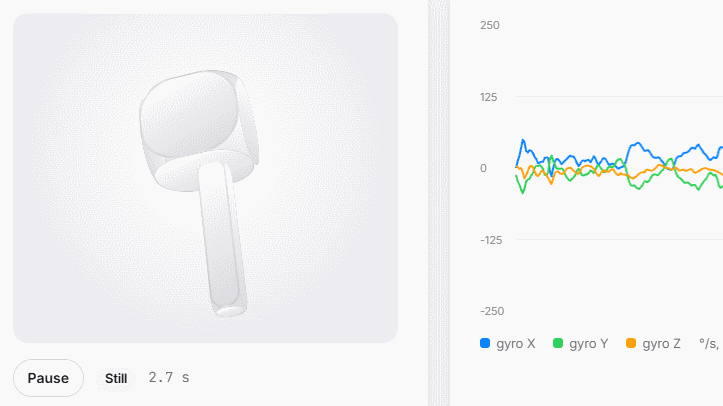
MousePods is a Python tool that reads motion sensor data from Apple AirPods on Linux and turns it into mouse input, with no Apple host needed. Matteo Gaudioso reverse-engineered the AirPods 3, which behave differently from other AirPods models and had resisted earlier head-tracking tools. He used Claude Code to run hundreds of probes against the devices. The key discovery: Linux's default MTU is too small to carry the full sensor payload, and raising it to match iOS's larger default reveals the missing motion data. MousePods also outputs to opentrack for head tracking in flight or racing simulators. It's confirmed working on AirPods 3 and AirPods Pro 2.
Source: https://hackaday.com/2026/11/06/mousepods-reverse-engineers-head-tracking-data-from-stubborn-airpods. 8 Sync News only summarizes and links out; content copyright belongs to the authors and original sources.
8 Sync ecosystem
One account, the whole ecosystem
Read the news here, practice coding, follow structured courses and train for IELTS on our sibling products — all connected through one 8 Sync account.
8syncdev.com
8syncdev.comThe ecosystem home: product overviews, blog and full pricing.
ExploreCourses
course.8syncdev.comLearn along a clear roadmap: videos, auto-graded quizzes, certificates and mentors who ship for a living.
View the roadmapCoding practice
coding.8syncdev.com1,000 DSA problems in Vietnamese, auto-graded across 7 languages — many FREE, right in your browser.
Practice for freeIELTS
ielts.8syncdev.comAI grading for all four IELTS skills with detailed rubric feedback.
Try it freeZUS — AI IDE
zus.8syncdev.comA 22 MB AI IDE for Vietnamese devs.
Download freemind0
mind0.8syncdev.comOrganizational memory for AI agents.
ExploreAcoLeads
home-acoleads.8syncdev.comAI that staffs your Fanpage and qualifies leads for you.
Try itRecommended for you

XDA Developers4 Hot3 min
Replacing Raspberry Pi OS with this lightweight distro made my SBC faster than any hardware upgrade
Software was slowing down my Pi.

XDA Developers1 Hot4 min
The PlayStation 3 briefly made buying a console a way to buy a Linux computer
It was a little too good at what it did, though.

Noted6 Hot4 min
Tailscale Subnet Routing: Access Your Entire Homelab
Learn how to configure Tailscale subnet routing to securely access your home network remotely without installing Tailscale on every device.

freeCodeCamp240 Hot2 min
Learn Real-World Penetration Testing: Hands-On Ethical Hacking Crash Course
Understanding how malicious actors infiltrate networks is the first step to building resilient infrastructure. To help developers and aspiring security analysts learn the fundamentals of offensive sec

Hacker News1 Hot16 min
Llama-modchip: 284B DeepSeek on 64GB RAM, no GPU
🐋 Run 284B DeepSeek-V4-Flash (<59GiB RAM, 44.4 tok/s pp, 9.1-14.7 tok/s) & 30B MoEs (25-111 tok/s) on a pure 64GB CPU at 256K ctx (0 GPUs). SwiGLU-H2, Stockfish-PVS L3 & 13ms Claude Code restore. - synchopate/llama-modchip

Bram.us345 Hot1 minAI
GTA.js, a reimplementation of the 1997 Grand Theft Auto engine in JavaScript and WebGL
Dự án GTA.js tái tạo lại engine của game Grand Theft Auto năm 1997 bằng JavaScript và WebGL, có thể chơi tại gtajs.wtf. Đây là bản reimplement chứ không phải emulator, nên một số vật lý và animation khác với bản gốc, nhưng engine nhiệm vụ chính xác dựa trên tài liệu mtd.doc. Tác giả sử dụng Gemini AI để triển khai hầu hết các tính năng, tham khảo tài liệu mở, ghi chú cộng đồng và trí nhớ cá nhân về game. Hiện tại game đã chơi được nhưng cảnh sát (cops) vẫn chưa được implement.
Lập trình viên nên đọc bài này để khám phá cách tái tạo lại engine game cổ bằng JavaScript và WebGL từ con số không.

Hacker News1 Hot3 min
ISponsorBlockTV: SponsorBlock client for all YouTube TV clients
SponsorBlock client for all YouTube TV clients. Contribute to dmunozv04/iSponsorBlockTV development by creating an account on GitHub.

ByteByteGo121 Hot4 minAI
EP230: RAG vs Agentic RAG
RAG (Retrieval-Augmented Generation) và Agentic RAG là hai phương pháp xử lý thông tin khác nhau trong lĩnh vực AI. RAG hoạt động bằng cách truy vấn vector database để tìm thông tin liên quan trước khi tạo câu trả lời, ví dụ như với vector database có thể chứa hàng triệu document embeddings. Agentic RAG thêm vào một agent có khả năng tự suy luận, cho phép hệ thống tự động xác định cần tìm thêm thông tin hay không, như trường hợp của OpenAI's GPT-4 với function calling. Sự khác biệt chính là Agentic RAG có khả năng tự chủ trong việc quyết định cần làm gì tiếp theo thay vì chỉ phụ thuộc vào kết quả truy vấn ban đầu. Đây là kiến thức quan trọng để hiểu sự tiến hóa từ RAG cơ bản đến các hệ thống thông minh hơn có khả năng tự điều chỉnh.
Bài viết này giúp bạn hiểu rõ sự khác biệt cơ bản giữa RAG và Agentic RAG để áp dụng hiệu quả vào các dự án AI.
Comments
Loading comments…