Loading feed…

depesz0 Hot0 comments3 min read
What LLMs do to PostgreSQL and DBAs
Bug reports on the pgsql-bugs mailing list rose between May and September, while pgsql-general traffic fell. Depesz attributes this to LLMs: more people use AI to research and find bugs, but also use AI instead of asking questions on mailing lists. IRC traffic also dropped, from an average of 5900 messages per month in 2024 to about 700 per month recently. Slack and Discord discussions have nearly disappeared too. Traffic to the explain.depesz.com query plan visualizer also fell significantly, which the author partly attributes to people moving to other visualizers and, he guesses, to people trusting LLMs to optimize queries without reading the explain output themselves.
Source: https://www.depesz.com/2026/11/09/what-llms-do-to-postgresql-and-dbas. 8 Sync News only summarizes and links out; content copyright belongs to the authors and original sources.
8 Sync ecosystem
One account, the whole ecosystem
Read the news here, practice coding, follow structured courses and train for IELTS on our sibling products — all connected through one 8 Sync account.
8syncdev.com
8syncdev.comThe ecosystem home: product overviews, blog and full pricing.
ExploreCourses
course.8syncdev.comLearn along a clear roadmap: videos, auto-graded quizzes, certificates and mentors who ship for a living.
View the roadmapCoding practice
coding.8syncdev.com1,000 DSA problems in Vietnamese, auto-graded across 7 languages — many FREE, right in your browser.
Practice for freeIELTS
ielts.8syncdev.comAI grading for all four IELTS skills with detailed rubric feedback.
Try it freeZUS — AI IDE
zus.8syncdev.comA 22 MB AI IDE for Vietnamese devs.
Download freemind0
mind0.8syncdev.comOrganizational memory for AI agents.
ExploreAcoLeads
home-acoleads.8syncdev.comAI that staffs your Fanpage and qualifies leads for you.
Try itRecommended for you

Hacker News1 Hot6 min
Ultorg: The User Interface for Relational Databases
Ultorg is an efficient, spreadsheet-like user interface for relational databases. Query and edit data across tables and relationships, without SQL.

Noted1 Hot4 min
Anchor: A Self-Hosted Note-Taking App That Works Offline
Anchor is a self-hosted notes app with offline editing, mobile apps, automatic syncing, note sharing, and Docker support.

Flavio Copes1 Hot12 min
API pricing vs subscription: what my month of Codex would cost on the API
I priced 30 days of my real Codex usage at API rates. A $100 plan covered $745 of API-equivalent work. Here's the math, the script to run on your own logs, and when the API still wins.

Latest Hacking News1 Hot7 min
Red Flags to Watch for When Choosing Between AI Pentesting Vendors
Choosing between AI pentesting vendors requires looking past marketing labels like 'autonomous' or 'agentic' because the underlying systems vary widely. A Stanford-led study ran different AI agent frameworks against a live 8,000-host network and found that between 55% and 82% of reported findings were confirmed as real vulnerabilities. Swapping only the underlying model moved one framework's valid finding rate from 57% to 80%, yet that same framework still scored lowest overall since its findings stayed shallow. On a CTF-style benchmark two frameworks scored near-identically (48.6% vs 45.9%), but on the live network one scored nearly three times higher on severity and complexity. Buyers should demand proof of exploitation, real-network results, clear safety controls, data handling answers and clarity on what 'continuous' actually means.

Kogan.com0 Hot10 min
Eventually Consistent: How Do We Know the Systems Eventually Agree?
Event-driven systems only agree eventually. Here’s how we check they actually got there: deadlines, data ownership, and a reconciliation job that walks the floor.
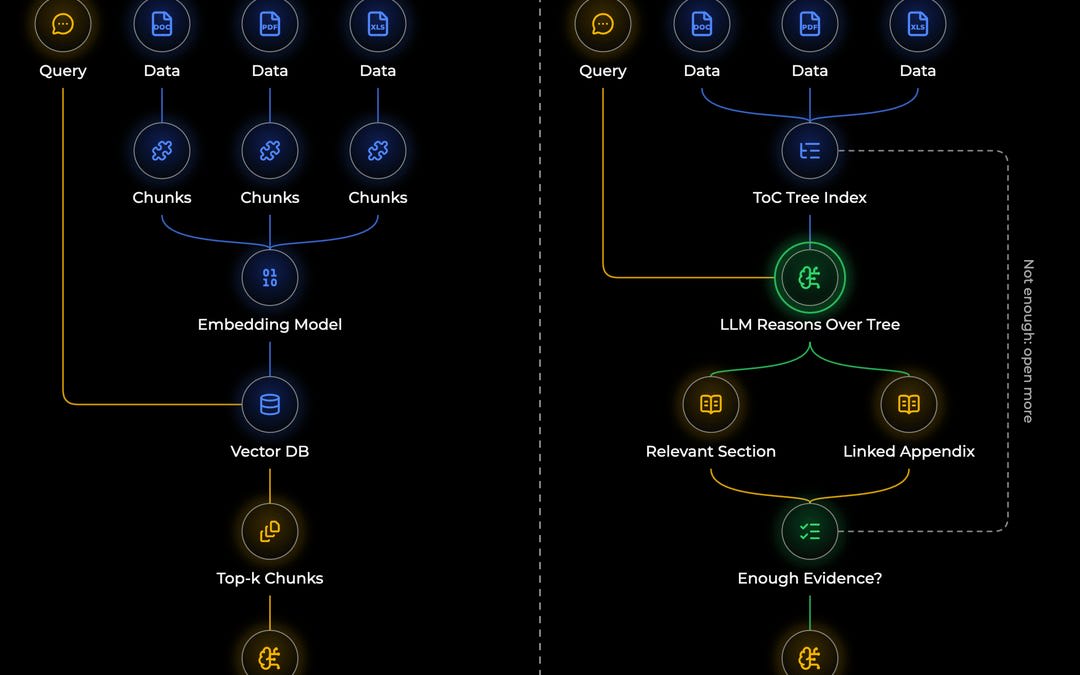
Daily Dose of Data Science | Avi Chawla | Substack152 Hot7 min
RAG vs. Vectorless RAG, clearly explained!
...explained visually (with tradeoffs in production).

Hacker News69 Hot1 min
OccupySaaS
OccupySaaS is a protest movement in code: laid-off developers building clean-room, open-source, drop-in replacements for the SaaS giants. First up: ZeroAuthy (Auth0) and SalesCompel (Salesforce).

Planet PostgreSQL4 Hot15 min
json vs jsonb in PostgreSQL: size and speed, measured
json vs jsonb in PostgreSQL 17 and 18, measured on six document shapes: when jsonb is 23% smaller or 41% larger, read speed, GIN, and what it changes.
Comments
Loading comments…